

September 18, 2026 0 Comments
GST Return & Statement Forms: Complete Guide to Who Files What and When
GST compliance is not limited to filing GSTR-1 and GSTR-3B. Depending on the type of taxpayer, business activity, registration category and filing scheme, different GST returns and statements may apply.
A taxpayer may have to deal with forms such as GSTR-1, GSTR-1A, GSTR-3B, GSTR-5, GSTR-6, GSTR-7, GSTR-8, GSTR-9, GSTR-9C, GSTR-10, GSTR-11, CMP-08 and GSTR-4.
The important point is that not every taxpayer has to file every form.
1. Regular Taxpayer – Monthly or Quarterly Filing
Regular taxpayers generally report their outward supplies through GSTR-1 and discharge their GST liability through GSTR-3B.
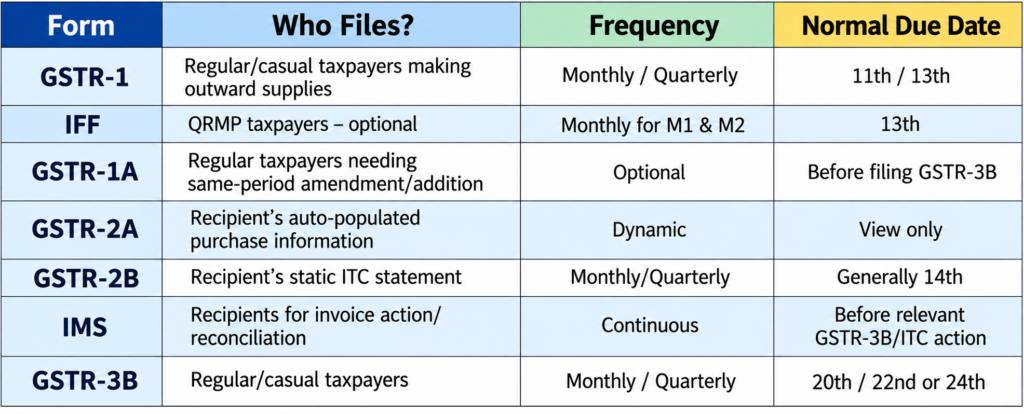
The GST Portal states that GSTR-1 is the statement of outward supplies and can be filed monthly or quarterly. The normal due date is the 11th of the following month for monthly filers and the 13th of the month following the quarter for quarterly filers, subject to government extensions.
GSTR-1
GSTR-1 contains details of outward supplies, including:
- B2B invoices
- B2C supplies
- Exports
- Credit notes
- Debit notes
- Advances
- Amendments
- Nil/exempt/non-GST supplies
- HSN-wise details
- Certain e-commerce supplies
GSTR-1 must generally be filed even when there is no business activity for the period.
GSTR-1A – Amendment Facility
GSTR-1A is an optional facility introduced to allow taxpayers to add or amend certain details of the same tax period after GSTR-1 and before GSTR-3B.
It can be filed only once for a tax period and is not available after GSTR-3B for that period has been filed.
GSTR-2A vs GSTR-2B
This distinction is extremely important for ITC reconciliation.
GSTR-2A is a dynamic statement that changes as suppliers upload or amend their documents.
GSTR-2B is a static, read-only ITC statement generated for the recipient. For monthly recipients, GSTR-2B is generated on the 14th of the succeeding month.
Therefore, businesses should regularly reconcile:
Purchase Register → GSTR-2B → IMS → Eligible ITC → GSTR-3B
2. GSTR-3B – Summary Return
GSTR-3B is a simplified summary return used to declare GST liability and discharge the tax payable.
It generally contains:
- Outward taxable supplies
- Reverse-charge supplies
- Eligible ITC
- ITC reversals
- Tax liability
- Interest and other amounts
- Tax payment details
For monthly filers, the normal due date is the 20th of the following month.
For quarterly filers under QRMP, the due date is generally the 22nd or 24th, depending on the State/UT.
For example, Telangana falls in the 22nd-day group under the QRMP framework described by GSTN.
3. QRMP Scheme – Quarterly Filing
The Quarterly Return Monthly Payment (QRMP) scheme is designed for eligible smaller taxpayers.
A taxpayer eligible for quarterly filing can file:
- GSTR-1 quarterly
- GSTR-3B quarterly
The taxpayer can also use IFF – Invoice Furnishing Facility for the first two months of the quarter.
Why use IFF?
IFF allows eligible QRMP taxpayers to report specified B2B invoices and related documents during the first two months.
It is optional, not compulsory.
Example
For April–June quarter:
April → IFF optional
May → IFF optional
June → GSTR-1 + GSTR-3B
4. Composition Scheme
The Composition Scheme provides a simplified compliance mechanism for eligible small taxpayers.
Instead of following the regular monthly/quarterly return system, composition taxpayers have a separate compliance structure.
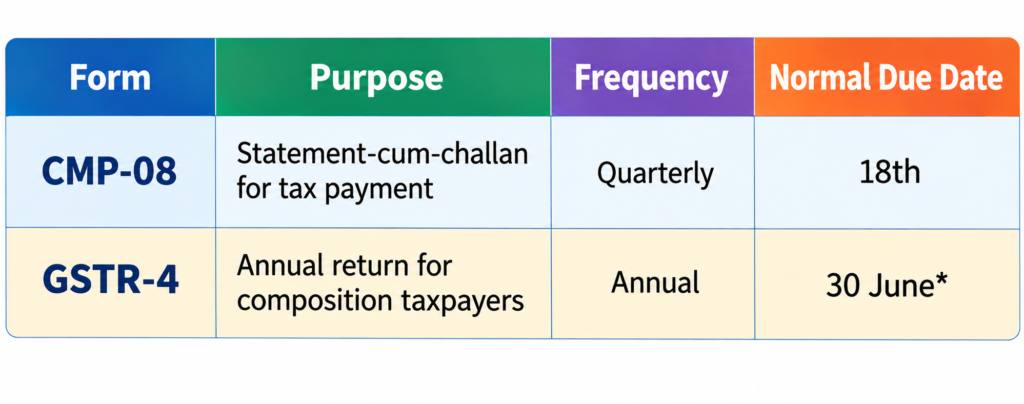
*Subject to applicable rules/notifications for the relevant financial year.
CMP-08
CMP-08 is used by composition taxpayers to declare their quarterly turnover and pay the applicable tax.
It is generally filed every quarter by the 18th of the month following the quarter.
GSTR-4
GSTR-4 is the annual return applicable to composition taxpayers for the relevant periods.
Composition taxpayers should not assume that the regular GSTR-1/GSTR-3B filing cycle applies to them.
5. Special Category Taxpayers
Certain taxpayers have separate GST reporting requirements.
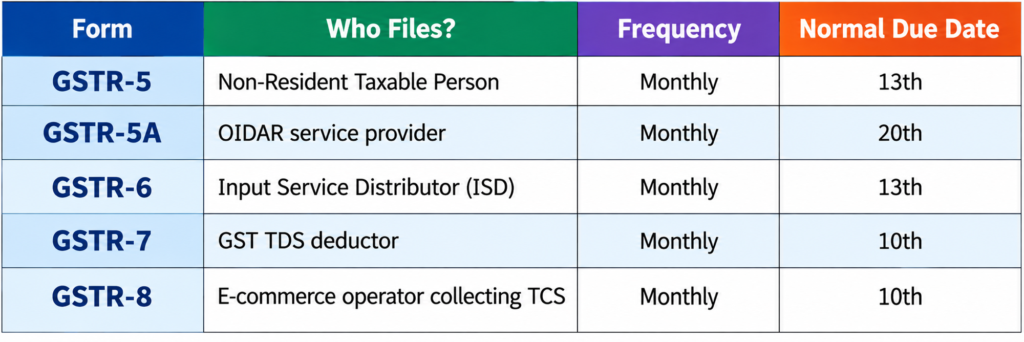
GSTN’s taxpayer guide confirms these broad filing frequencies and due dates.
GSTR-5 – Non-Resident Taxable Person
GSTR-5 is filed by a Non-Resident Taxable Person (NRTP).
It reports the taxpayer’s:
- Outward supplies
- Inward supplies
- Tax liability
- ITC
- Tax payments
For applicable monthly periods, the due date is generally the 13th of the succeeding month. Certain registration-closure situations have separate timing rules.
GSTR-5A – OIDAR Services
GSTR-5A applies to specified OIDAR service providers located outside India supplying services to non-taxable persons in India.
It is generally filed monthly.
GSTR-6 – Input Service Distributor
GSTR-6 is filed by an Input Service Distributor (ISD).
Its purpose is to report the distribution of eligible input tax credit among the appropriate units/registrations.
The normal due date is the 13th of the following month.
GSTR-7 – GST TDS
GSTR-7 is filed by persons required to deduct GST TDS under the applicable provisions.
It generally contains:
- GSTIN of deductee
- Value on which TDS is deducted
- TDS amount
- Details of tax deducted
The normal due date is the 10th of the following month.
GSTR-8 – E-Commerce TCS
GSTR-8 is the statement filed by an e-commerce operator required to collect TCS under GST.
It contains details relating to supplies made through the electronic commerce operator and the TCS collected.
The normal due date is the 10th of the following month.
6. Annual Returns and Final Returns
Annual and final forms are important because they consolidate information reported during the financial year.
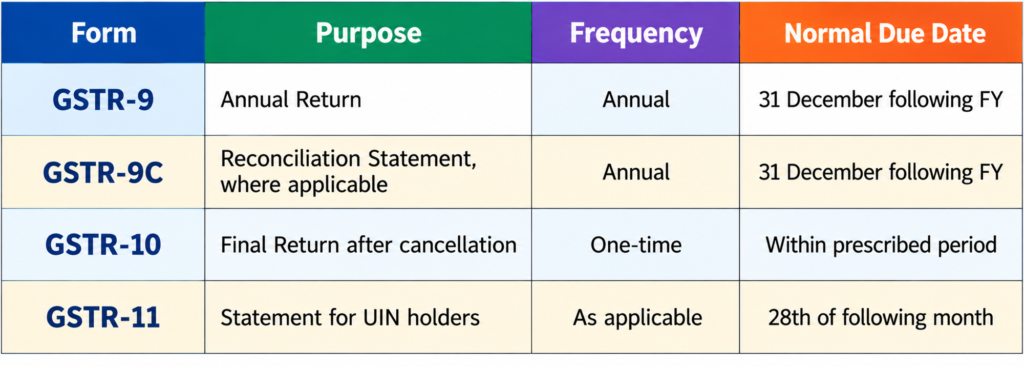
GSTN’s taxpayer guide identifies 31 December of the following financial year as the general due date for GSTR-9 and GSTR-9C, subject to the applicable statutory conditions and notifications.
7. GSTR-9 – Annual Return
GSTR-9 provides an annual summary of GST activities.
It broadly consolidates information relating to:
- Outward supplies
- Inward supplies
- ITC
- Tax paid
- Amendments
- HSN information
- Other annual GST details
It should be reconciled with:
GSTR-1 + GSTR-3B + GSTR-2B + Books of Accounts + Tax Ledgers
Before filing GSTR-9, businesses should reconcile the annual turnover and tax figures rather than simply relying on auto-populated information.
8. GSTR-9C – Reconciliation Statement
GSTR-9C is a reconciliation statement that compares GST turnover and tax figures with the financial statements.
It is applicable to taxpayers crossing the prescribed aggregate-turnover threshold, subject to the law and notifications applicable to the relevant financial year.
GSTN describes GSTR-9C as a reconciliation statement to be furnished with GSTR-9 where the applicable threshold is crossed.
Therefore, taxpayers should check the threshold applicable for the particular financial year rather than assuming that the same threshold applies permanently.
9. GSTR-10 – Final Return
GSTR-10 is the final GST return generally applicable when GST registration is cancelled or surrendered.
It is a one-time return and should not be confused with the regular monthly/quarterly returns.
The taxpayer should ensure that:
- Outstanding liabilities are identified
- ITC reversal, where applicable, is calculated
- Stock details are considered
- Tax dues are paid
- Final return is filed within the prescribed time
10. GSTR-11 – UIN Holders
GSTR-11 is associated with persons holding a Unique Identification Number (UIN).
It is used to report inward supplies on which refund of GST may be claimed under the applicable provisions.
11. Important GST Reconciliation Before Filing
A good GST compliance process should not start with simply opening the GST portal.
Businesses should first reconcile their records.
Sales Reconciliation
Sales Register
↓
GSTR-1
↓
GSTR-3B
↓
E-Invoice Data, where applicable
Purchase & ITC Reconciliation
Purchase Register
↓
GSTR-2B
↓
IMS
↓
Eligible ITC
↓
GSTR-3B
GSTR-2B contains supplier-uploaded documents from GSTR-1/1A/IFF, GSTR-5 and GSTR-6, along with relevant import data.
12. GSTR-1 and GSTR-3B Should Match
One of the most important checks for a taxpayer is the relationship between GSTR-1 and GSTR-3B.
For example:
If outward taxable supplies reported in GSTR-1 are:
₹10,00,000
but taxable turnover reported in GSTR-3B is:
₹7,00,000
there is a ₹3,00,000 difference that needs to be investigated.
Possible reasons include:
- Missed invoices
- Wrong reporting period
- Credit/debit note differences
- Amendments
- RCM transactions
- Exempt supplies
- Classification errors
- Data-entry mistakes
A reconciliation should be performed before filing, not after receiving a notice.
13. ITC Reconciliation – Why GSTR-2B Matters
Input Tax Credit should be reviewed carefully.
A practical reconciliation can include:
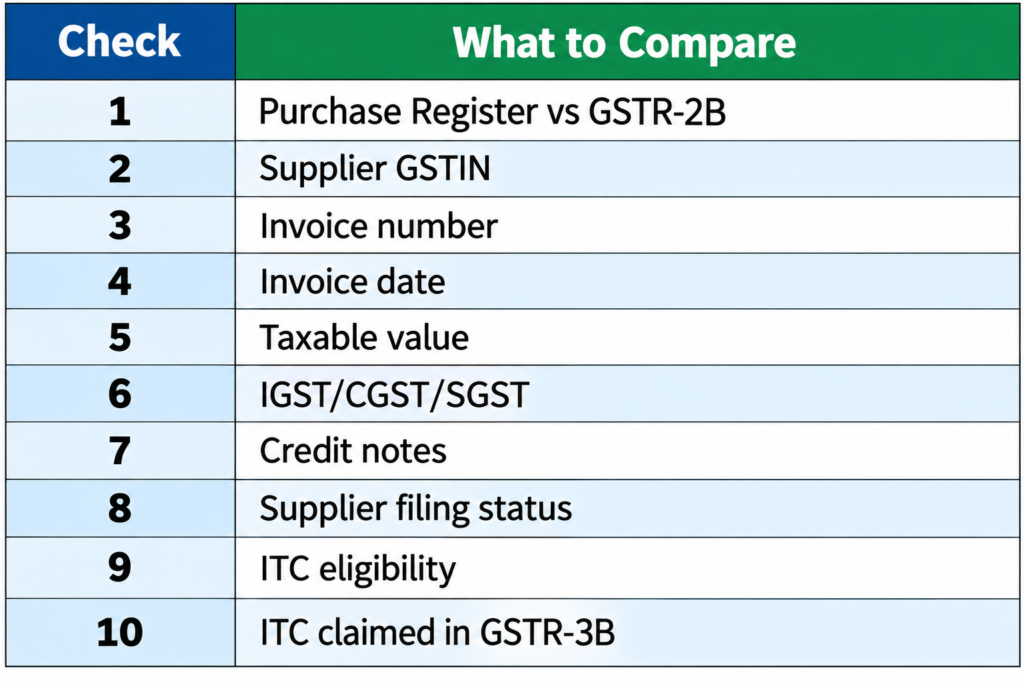
GSTR-2B is read-only and cannot be manually changed by the recipient.
14. Monthly GST Compliance Checklist
A business can follow this simple monthly process:
Step 1 – Collect sales data
Download the sales register from accounting software.
Step 2 – Check invoices
Verify:
- Invoice number
- Date
- GSTIN
- Taxable value
- GST rate
- Tax amount
- Place of supply
Step 3 – Reconcile GSTR-1
Check that all applicable outward supplies are correctly reported.
Step 4 – Review GSTR-1A
Where an error or omission is identified, check whether GSTR-1A can be used before filing GSTR-3B.
Step 5 – Download GSTR-2B
Check supplier invoices and eligible ITC.
Step 6 – Review IMS
Take appropriate action on applicable records.
Step 7 – Prepare GSTR-3B
Calculate:
Output GST – Eligible ITC = Net GST Liability
subject to the applicable GST rules.
Step 8 – Pay tax
Ensure the required amount is available in the appropriate electronic ledger.
Step 9 – File GSTR-3B
File within the applicable due date.
Step 10 – Reconcile after filing
Save:
- ARN
- Filed return
- Challan
- Tax payment details
- Reconciliation working papers
15. Quick GST Return Calendar
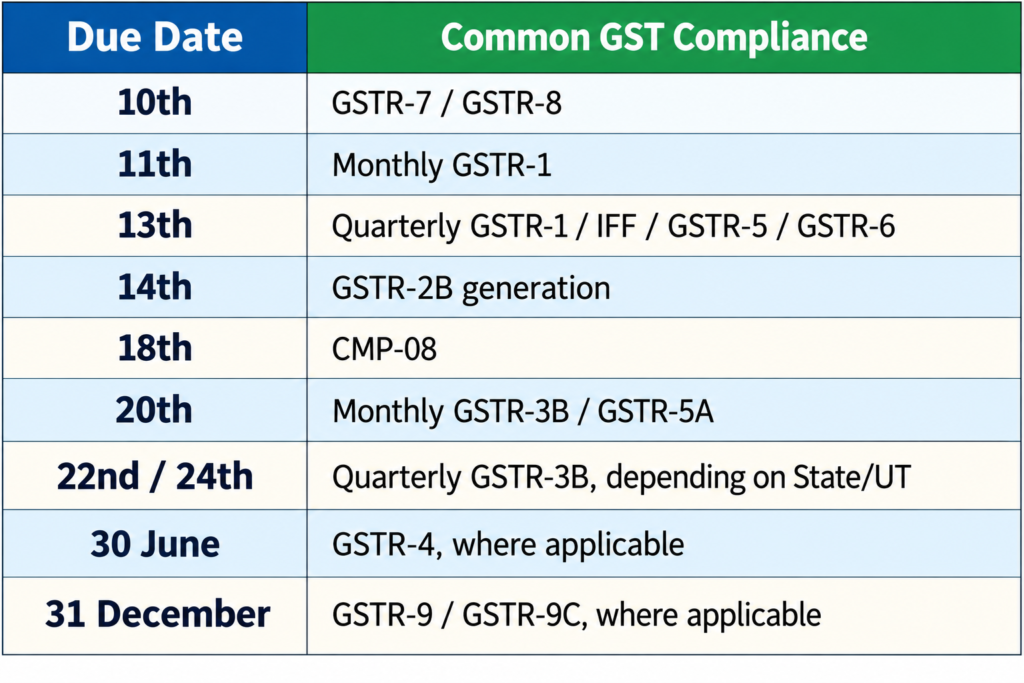
These are general due dates; government notifications can extend or modify dates for particular taxpayers, tax periods or locations. GSTN itself advises taxpayers to check applicable notifications for changes.
16. Important Corrections to the Infographic
The infographic is useful as a quick reference, but a few points need clarification:
GSTR-1A
It is not simply an “amendment return” filed on a fixed due date. It is an optional same-period amendment/addition facility available after GSTR-1 or its due date, whichever is later, and before GSTR-3B.
GSTR-2B
GSTR-2B is generally generated on the 14th, but it is an ITC statement, not a return that the taxpayer files.
GSTR-3B
The 20th applies to monthly filers, while quarterly filers generally have 22nd/24th due dates depending on the State/UT.
GSTR-5
For applicable periods from October 2022 onward, the monthly due date is generally 13th, rather than the older 20th rule.
17. Simple Way to Remember GST Forms
Regular Taxpayer
GSTR-1 → GSTR-1A → GSTR-2B/IMS → GSTR-3B
Composition Taxpayer
CMP-08 → GSTR-4
Special Taxpayers
GSTR-5 / 5A / 6 / 7 / 8
Annual Compliance
GSTR-9 → GSTR-9C, where applicable
Cancellation
GSTR-10
UIN
GSTR-11
Final Takeaway
GST return compliance is not just about remembering due dates. A taxpayer needs to understand which form applies, who has to file it, what information it contains, how it connects with other GST forms, and how the figures should be reconciled with the books.
For a regular taxpayer, the most important compliance chain is:
Sales Register → GSTR-1/GSTR-1A → GSTR-2B & IMS → ITC Reconciliation → GSTR-3B → Payment → Filing → Monthly Reconciliation
Keeping this cycle under control can help identify invoice mismatches, ITC differences and reporting errors before they become larger compliance issues.
Disclaimer: GST due dates and filing requirements can be changed or extended through notifications, circulars and GST Portal updates. Always verify the due date displayed on the GST Portal for the relevant taxpayer, State/UT and tax period before filing.