
October 4, 2026 0 Comments
GST Rule 86B: The 1% Cash Payment Rule Explained – Applicability, Exceptions and Practical Examples (FY 2026-27)
GST Rule 86B is an important provision under the Central Goods and Services Tax (CGST) Rules, 2017. It restricts certain registered taxpayers from using their Input Tax Credit (ITC) to pay 100% of their output GST liability.
Under this rule, eligible taxpayers must pay at least 1% of their output tax liability through the Electronic Cash Ledger, while the remaining 99% can be paid using the Electronic Credit Ledger, subject to available eligible ITC.
In this article, let us understand Rule 86B, its applicability, exceptions, practical examples and important points businesses should consider while filing GST returns.
1. What is GST Rule 86B?
Rule 86B was introduced through Notification No. 94/2020 – Central Tax dated 22 December 2020 and became effective from 1 January 2021.
The main objective of this rule is to restrict excessive utilisation of Input Tax Credit in certain cases and ensure a minimum cash payment of GST.
According to Rule 86B, a registered taxpayer cannot use ITC to discharge more than 99% of the output tax liability if the value of taxable supplies (excluding exempt and zero-rated supplies) exceeds ₹50 lakh in a month.
In simple words:
- Minimum 1% of output tax liability must be paid in cash.
- Maximum 99% of output tax liability can be paid through eligible ITC.
- The rule applies only when the prescribed monthly taxable supply threshold is crossed.
- Specified exceptions are available.
2. When is Rule 86B applicable?
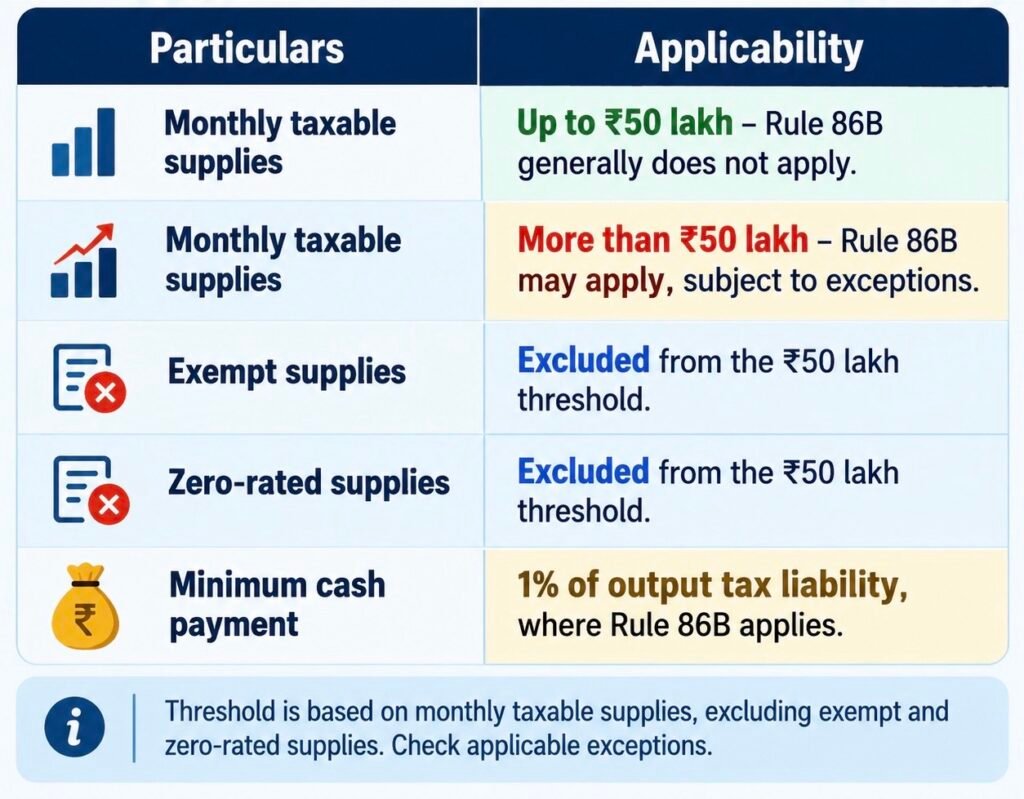
Rule 86B generally applies when the value of taxable supplies, excluding exempt supplies and zero-rated supplies, exceeds ₹50 lakh in a particular month.
3. How does the 1% cash payment rule work?
Under Rule 86B, the taxpayer must discharge at least 1% of the output tax liability through the Electronic Cash Ledger.
The remaining 99% can be paid through the Electronic Credit Ledger, subject to the availability and eligibility of ITC.
Practical Example
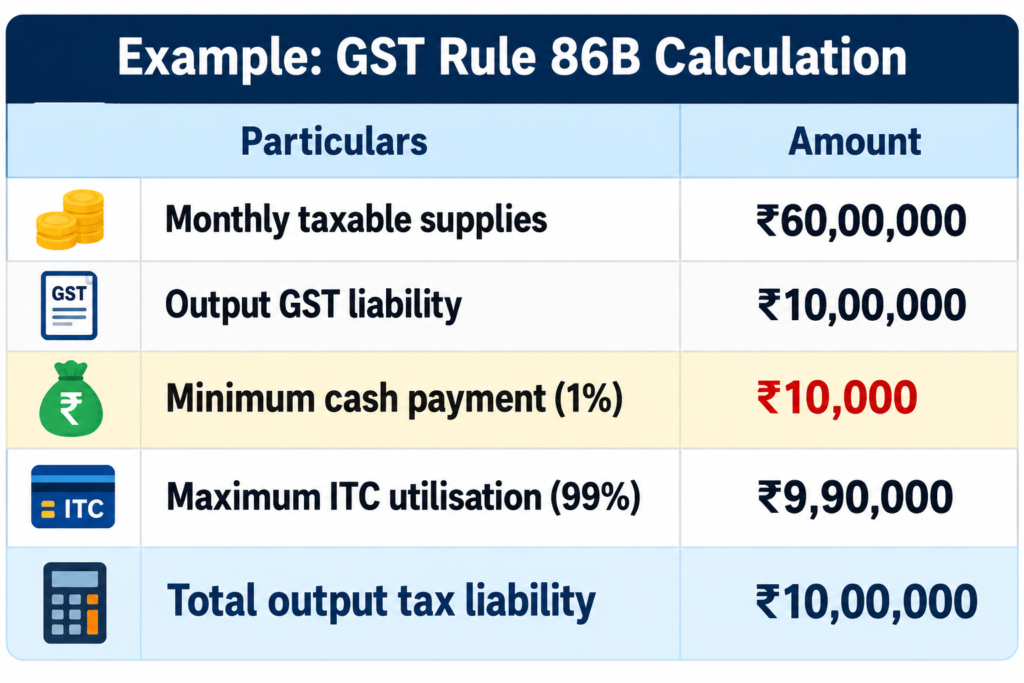
Suppose ABC Traders has the following transactions during a month:
Calculation:
Minimum cash payment = ₹10,00,000 × 1%
= ₹10,000
Therefore:
- ₹10,000 must be paid through the Electronic Cash Ledger.
- Up to ₹9,90,000 can be paid through eligible ITC.
This is the basic calculation under Rule 86B, assuming no exception applies.
4. When does Rule 86B NOT apply? – Important Exceptions
Rule 86B provides specific exceptions. If a registered taxpayer satisfies any one of the applicable conditions, the restriction does not apply.
Exception 1: Income Tax Paid More Than ₹1 Lakh
Rule 86B does not apply if the registered person or specified individuals have paid more than ₹1 lakh as income tax in each of the last two financial years for which the return filing due date under Section 139(1) has expired.
The specified persons include:
- The registered person.
- Proprietor, in the case of a proprietorship.
- Karta, in the case of an HUF.
- Managing Director.
- Any two partners.
- Whole-time Directors.
- Members of the Managing Committee of an Association.
- Board of Trustees.
Example:
Financial Year
Income Tax Paid
FY 2023-24
₹1,50,000
FY 2024-25
₹1,25,000
If the applicable conditions are satisfied, Rule 86B will not apply.
Note: The amount must be more than ₹1 lakh in each of the two relevant financial years, not merely an aggregate of ₹1 lakh.
Exception 2: Refund of Unutilised ITC on Zero-Rated Supplies
Rule 86B does not apply if the taxpayer received a refund exceeding ₹1 lakh in the preceding financial year on account of unutilised ITC relating to zero-rated supplies made without payment of tax.
Examples include:
- Export of goods or services under LUT.
- Supplies to SEZ units or SEZ developers without payment of tax.
Example:
An exporter received an unutilised ITC refund of ₹2 lakh during FY 2025-26 on account of eligible zero-rated supplies.
If the prescribed conditions are satisfied, Rule 86B will not apply.
Exception 3: Refund Due to Inverted Duty Structure
Rule 86B also does not apply if the registered taxpayer received a refund exceeding ₹1 lakh in the preceding financial year due to an inverted duty structure.
An inverted duty structure occurs when the GST rate on inputs is higher than the GST rate on output supplies, resulting in an accumulation of ITC.
Example:
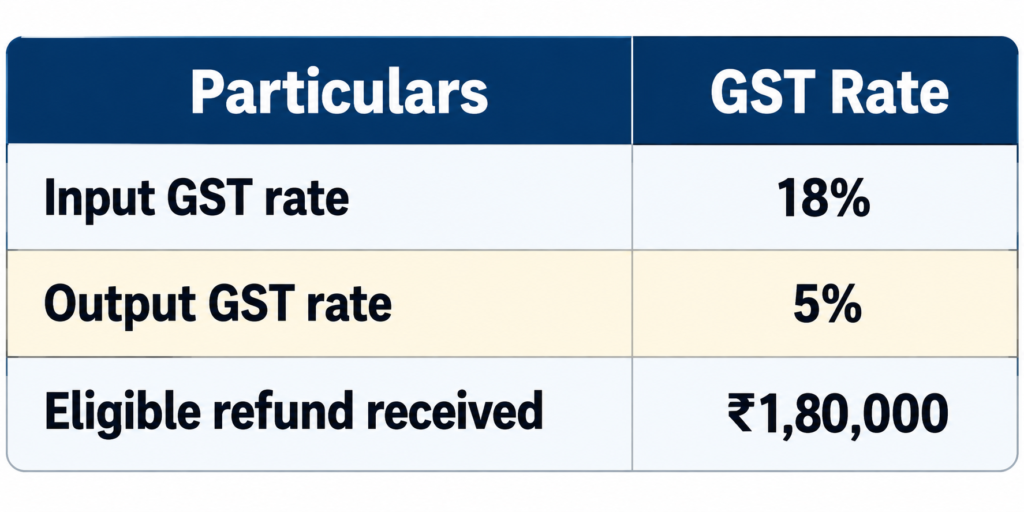
If the taxpayer received a qualifying refund exceeding ₹1 lakh in the preceding financial year, the Rule 86B restriction will not apply.
Exception 4: More Than 1% Output Tax Already Paid in Cash
This is an important exception that many taxpayers should understand.
If the registered person has already discharged more than 1% of the total output tax liability through the Electronic Cash Ledger, calculated cumulatively up to the relevant month in the current financial year, Rule 86B does not apply.
Example:
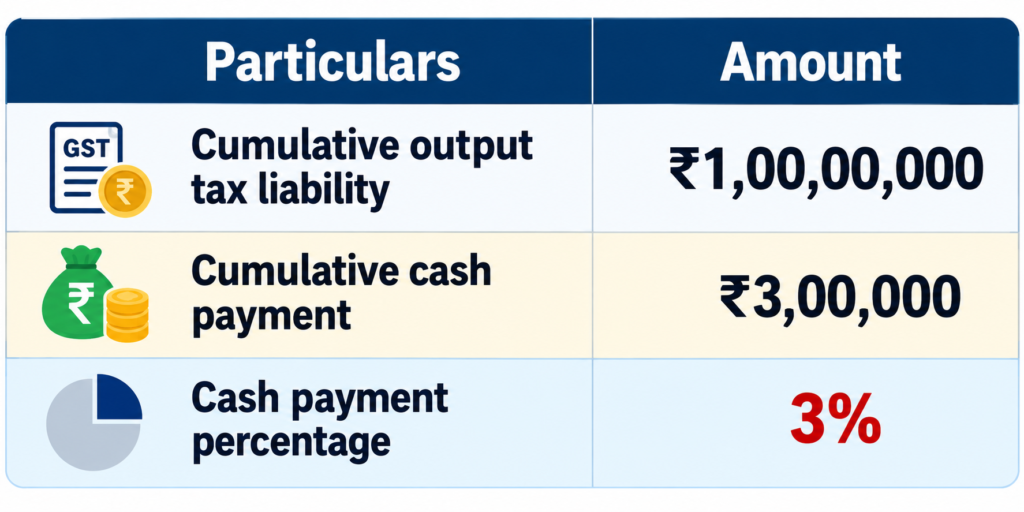
Since the taxpayer has already paid 3% of the cumulative output tax liability in cash, which is more than 1%, the Rule 86B restriction does not apply.
Important: This exception is calculated cumulatively for the financial year up to the relevant month, not separately for each month.
Exception 5: Government Departments, PSUs and Specified Bodies
Rule 86B does not apply to the following registered entities:
- Government Departments.
- Public Sector Undertakings (PSUs).
- Local Authorities.
- Statutory Bodies.
Example:
A registered local authority makes taxable supplies exceeding ₹50 lakh in a month.
The Rule 86B restriction will not apply if the entity falls within the specified category.
Exception 6: Specified Goods Under Rule 31D
With effect from 1 February 2026, an additional provision was introduced under Rule 86B.
A registered person other than a manufacturer is exempt from Rule 86B only in respect of goods specified under Rule 31D, where the supplier has paid tax on the basis of the retail sale price.
This is a limited, goods-specific exception and should not be treated as a general exemption for all traders.
5. Practical Difference Between ITC Payment and Cash Payment
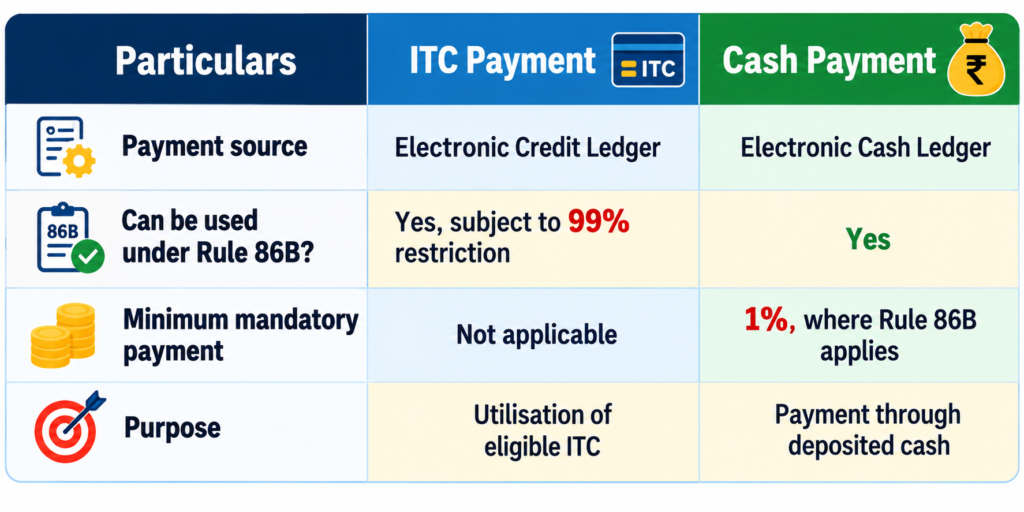
6. Important Points to Remember
- The ₹50 lakh threshold is calculated on monthly taxable supplies excluding exempt and zero-rated supplies.
- The 1% cash requirement is calculated on output tax liability, not taxable turnover.
- The income tax exception requires more than ₹1 lakh in each of the two relevant financial years.
- Refund exceptions require qualifying refunds exceeding ₹1 lakh in the preceding financial year.
- The cumulative cash payment exception is calculated from the beginning of the financial year up to the relevant month.
- Government Departments, PSUs, Local Authorities and Statutory Bodies are covered by the specified exception.
- Rule 31D provides an additional limited exception effective from 1 February 2026.
- Maintain supporting documents for all exceptions claimed.
7. GST Compliance Checklist
Before filing GSTR-3B, taxpayers should verify:
- Whether monthly taxable supplies exceed ₹50 lakh.
- Whether exempt and zero-rated supplies have been excluded.
- Whether Rule 86B applies.
- Whether any specified exception is available.
- Whether the minimum cash payment has been made.
- Whether sufficient eligible ITC is available.
- Whether cumulative cash payments have crossed 1% of cumulative output tax liability.
Conclusion
GST Rule 86B is an important compliance provision that affects the utilisation of Input Tax Credit for certain registered taxpayers.
Businesses crossing the ₹50 lakh monthly taxable supply threshold should carefully examine the 1% cash payment requirement before filing GSTR-3B.
However, taxpayers should also check all the available exceptions, as Rule 86B does not apply when the prescribed conditions are satisfied.
Proper GST reconciliation, cash ledger verification and ITC utilisation checks can help businesses avoid unnecessary compliance issues.
Stay updated with GST rules, practical taxation and finance courses at ExpertMantra.
Visit: https://www.expertmantra.com
Disclaimer: This article is for educational and informational purposes only. Taxpayers should verify the latest GST provisions, notifications and applicable conditions before filing returns.