
September 30, 2026 0 Comments
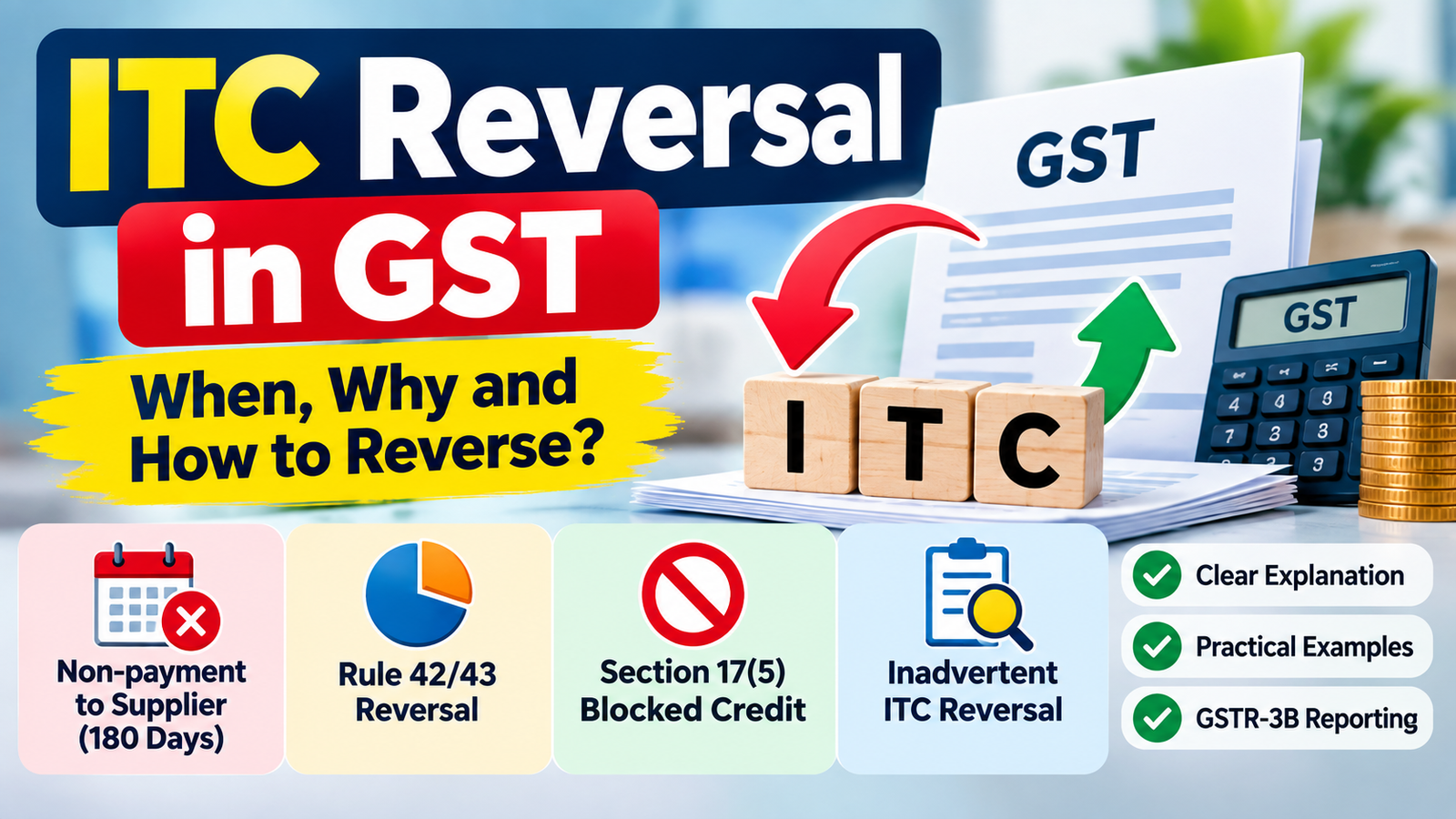
ITC Reversal under GST: When, Why and How to Reverse Input Tax Credit
Input Tax Credit (ITC) is one of the most important features of the GST system. It allows a registered taxpayer to set off eligible GST paid on purchases against GST payable on outward supplies.
However, ITC cannot always be retained once it has been claimed. In certain situations, the GST law requires the taxpayer to reverse the credit already availed. Some reversals are permanent, while others can be reclaimed later when the prescribed conditions are fulfilled.
This article explains the major situations requiring ITC reversal, the relevant GST provisions, reporting in GSTR-3B, and practical examples.
1. What is ITC Reversal?
ITC reversal means reducing or reversing Input Tax Credit that was previously availed, or that is otherwise required to be excluded from the credit available to the taxpayer.
The purpose is to ensure that ITC is ultimately available only to the extent permitted under GST law.
For example:
A business purchases goods for ₹1,00,000 plus GST of ₹18,000 and initially claims ₹18,000 as ITC. If a statutory condition subsequently requires reversal of that credit, the appropriate amount must be reversed in GSTR-3B.
The exact treatment depends on the reason for reversal.
2. Major Situations Where ITC May Have to Be Reversed
A. Non-payment to Supplier – 180-Day Rule
One of the most common situations is failure to pay the supplier.
Where the recipient has availed ITC but does not pay the supplier the value of the supply plus the GST payable within 180 days from the date of invoice, the ITC attributable to the unpaid amount is required to be reversed under the applicable provisions.
CBIC’s Rule 37 deals with reversal for non-payment of consideration.
Example
Suppose:
- Invoice value = ₹1,00,000
- GST @ 18% = ₹18,000
- ITC claimed = ₹18,000
- Payment is not made within 180 days.
The applicable ITC is reversed through the prescribed GSTR-3B reporting mechanism.
Important: This type of reversal is generally reclaimable after the taxpayer subsequently makes the required payment to the supplier along with tax.
3. ITC on Lost, Stolen, Destroyed or Written-Off Goods
ITC is restricted in respect of goods that are:
- Lost
- Stolen
- Destroyed
- Written off
- Disposed of by way of gift or free samples
subject to the specific provisions and exceptions under GST law.
These situations generally fall under the blocked-credit provisions of Section 17(5).
Therefore, businesses should maintain proper records relating to inventory losses, insurance claims, write-offs and destruction of goods.
4. Motor Vehicles
ITC relating to motor vehicles is subject to specific restrictions.
Section 17(5) generally restricts ITC on specified motor vehicles, subject to exceptions based on the nature and use of the vehicle.
For example, different treatment may apply where vehicles are used for specified taxable activities such as:
- Further supply of such vehicles
- Transportation of passengers
- Imparting training on driving such vehicles
Therefore, businesses should not automatically assume that GST paid on every business vehicle is eligible for ITC.
5. Food, Beverages and Certain Personal/Employee-Related Expenses
ITC may be blocked for specified expenses such as:
- Food and beverages
- Outdoor catering
- Beauty treatment
- Health services
- Membership of clubs and similar categories
Section 17(5) contains specific restrictions and exceptions. Therefore, eligibility must be examined based on the exact nature of the expense and applicable exception.
Practical tip: Do not classify an expense as eligible merely because the invoice contains a valid GSTIN and GST amount.
6. Construction of Immovable Property
ITC restrictions can apply to goods or services used for construction of an immovable property, subject to the detailed provisions and exceptions under Section 17(5).
This is particularly relevant for:
- Construction projects
- Office buildings
- Commercial premises
- Renovation and related expenditure
The distinction between plant and machinery and other immovable property is important, so the exact facts should be examined before reversing or claiming ITC.
7. Goods or Services Used for Non-Business Purposes
Where goods or services are used partly for business and partly for non-business purposes, ITC is restricted to the portion attributable to business use.
Section 17(1) specifically provides for restriction of credit to the portion attributable to business purposes.
Example
A service costs ₹1,00,000 + ₹18,000 GST.
If only 80% of the service is attributable to business use, the eligible credit may need to be determined accordingly, subject to the applicable provisions.
8. Common ITC Used for Taxable and Exempt Supplies
If common inputs or input services are used for:
- Taxable supplies, including zero-rated supplies, and
- Exempt supplies,
the credit has to be appropriately apportioned.
Section 17(2) restricts ITC to the portion attributable to taxable supplies, including zero-rated supplies.
Rules 42 and 43 prescribe the mechanism for reversal relating to common inputs/input services and capital goods.
CBIC also identifies Rule 42 and Rule 43 reversals as non-reclaimable/absolute reversals for reporting purposes in GSTR-3B.
9. Free Samples and Promotional Goods
Businesses frequently distribute products as:
- Free samples
- Promotional materials
- Gifts
- Business promotion items
The ITC treatment depends on the exact nature of the transaction and the applicable GST provisions.
A particularly important point is that not every item supplied free of charge automatically requires reversal. For example, CBIC’s FAQ explains that where free replacement is supplied under warranty without consideration, ITC need not necessarily be reversed merely because the replacement is free.
Therefore, businesses should examine the transaction rather than applying a blanket reversal rule.
10. Change in Use of Goods or Services
If goods or services originally used for business/taxable supplies are subsequently used for:
- Non-business purposes, or
- Exempt supplies,
appropriate ITC adjustment or reversal may be required under the applicable provisions.
This is particularly important for businesses whose taxable and exempt activities change during the financial year.
11. GSTR-3B: Where is ITC Reversal Reported?
The current GSTR-3B reporting structure separates ITC reversals into different categories.
Table 4(B)(1)
This is used for specified non-reclaimable reversals, including reversals under:
- Rule 38
- Rule 42
- Rule 43
- Section 17(5)
as clarified by CBIC.
Table 4(B)(2)
This is used for other reversals, including specified reversals that may be reclaimable later, such as Rule 37 reversals relating to non-payment within 180 days.
When eligible conditions are subsequently fulfilled, the credit can be reclaimed through the prescribed reporting mechanism.
Table 4(D)(1)
Where ITC previously reversed in Table 4(B)(2) is subsequently reclaimed, the reclaimed amount is also required to be reported in Table 4(D)(1).
12. Role of GSTR-2B in ITC Reconciliation
GSTR-2B is an important source for reconciling ITC, but taxpayers must not assume that everything appearing as ITC available in GSTR-2B is automatically eligible.
GSTN explains that GSTR-2B contains both:
- ITC available information, and
- ITC not-available information.
There can also be other restrictions under GST law that require the taxpayer to independently determine eligibility.
Therefore, the correct process is:
GSTR-2B → Books/Purchase Register → Eligibility Check → Reconciliation → GSTR-3B
13. ITC Reversal vs ITC Reclaim
This distinction is extremely important.
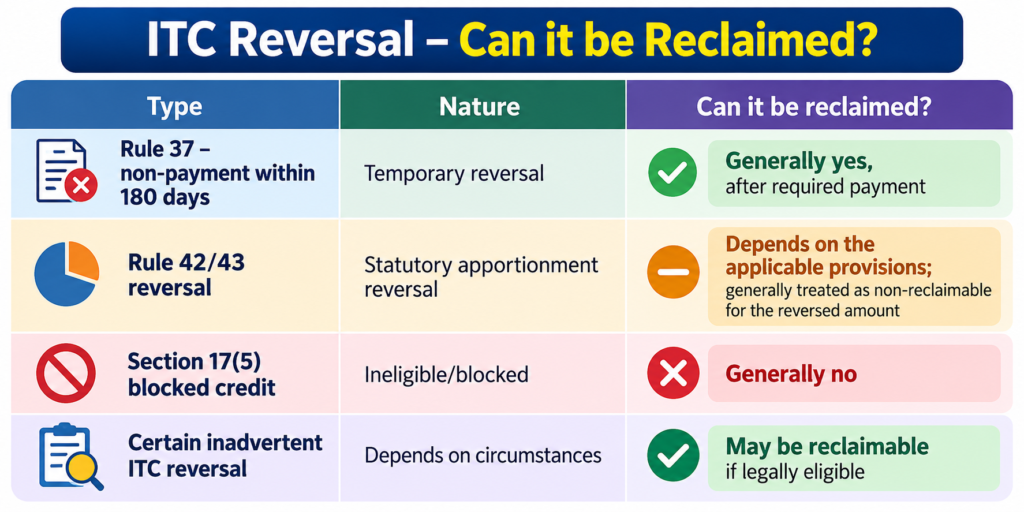
CBIC specifically distinguishes between reclaimable reversals reported in Table 4(B)(2) and absolute/non-reclaimable reversals reported in Table 4(B)(1).
14. Practical Example – 180-Day ITC Reversal
Suppose ABC Ltd. receives an invoice:
Taxable value: ₹1,00,000
GST @ 18%: ₹18,000
Total invoice: ₹1,18,000
ABC Ltd. claims ₹18,000 ITC.
However, the supplier is not paid within the prescribed 180-day period.
Initial position
ITC claimed = ₹18,000
On failure to make payment
The applicable ITC is reversed through the appropriate GSTR-3B reporting.
Later payment
ABC Ltd. subsequently pays the supplier the required amount.
Subject to fulfilment of the applicable conditions, the previously reversed ITC can be reclaimed.
This illustrates why taxpayers should maintain an ITC reversal and reclaim tracker.
15. ITC Reversal Checklist for Businesses
Before filing GSTR-3B, businesses should check:
Purchase reconciliation
☑ Compare purchase register with GSTR-2B
☑ Identify missing invoices
☑ Check duplicate invoices
☑ Check credit notes and debit notes
Eligibility
☑ Check Section 16 conditions
☑ Check blocked credits under Section 17(5)
☑ Check business vs non-business use
☑ Check taxable vs exempt use
☑ Check Rule 42/43 requirements where applicable
Supplier payment
☑ Identify invoices outstanding for more than 180 days
☑ Calculate ITC attributable to unpaid amounts
☑ Reverse applicable ITC
☑ Track later payments for possible reclaim
GSTR-3B
☑ Report eligible ITC correctly
☑ Report non-reclaimable reversals in 4(B)(1), where applicable
☑ Report other/reclaimable reversals in 4(B)(2), where applicable
☑ Report eligible reclaimed ITC in 4(A)(5) and disclose it in 4(D)(1), where applicable.
16. Common Mistakes in ITC Reversal
Mistake 1: Treating GSTR-2B as the final eligibility statement
GSTR-2B is an important reconciliation document, but the taxpayer must still determine eligibility under GST law.
Mistake 2: Reversing all ITC permanently
Some reversals are temporary and can be reclaimed when the required conditions are fulfilled.
Mistake 3: Ignoring the 180-day payment condition
Businesses should regularly review their invoice ageing and supplier outstanding reports.
Mistake 4: Incorrect GSTR-3B table
The taxpayer must distinguish between reversals under 4(B)(1) and 4(B)(2).
Mistake 5: Failing to track reclaimed ITC
Where ITC reversed in 4(B)(2) becomes eligible again, proper documentation and reporting are important.
Conclusion
ITC reversal is not simply an accounting adjustment—it is an important GST compliance requirement.
Businesses should regularly reconcile:
Books → Purchase Register → GSTR-2B → ITC Eligibility → Reversal → GSTR-3B → Reclaim
The key is to distinguish between permanent/ineligible ITC and temporary/reclaimable ITC.
Proper reconciliation, supplier-payment tracking and documentation can help businesses avoid incorrect ITC claims and unnecessary GST disputes.
Important: GST provisions and return formats can change through notifications, circulars and amendments. The above article reflects the provisions and GSTN/CBIC guidance identified in the sources checked for this article; taxpayers should verify the applicable law for the relevant tax period before filing.