
September 17, 2026 0 Comments
GST – ONE NATION ONE TAX
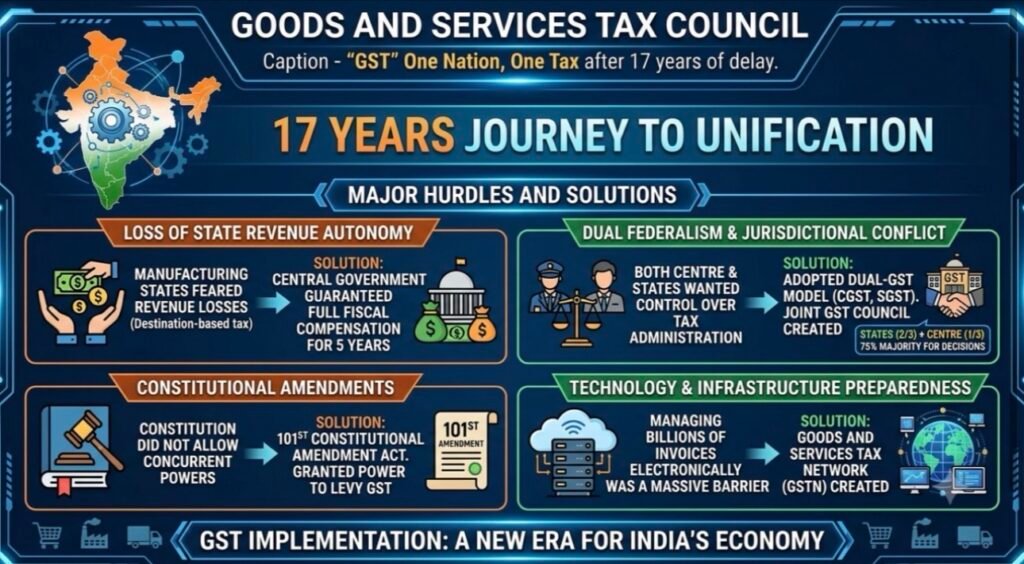
It took 17 years to conceptualize, finalize the governing framework, and implement the Goods and Services Tax (GST) in India.2000: The idea of a unified GST was first proposed under Prime Minister Atal Bihari Vajpayee, initiating the design process. September 2016: The GST Council was formally constituted via the 101st Constitutional Amendment Act to govern rate structures and policies. July 1, 2017: India officially rolled out GST nationwide.
Major Hurdles and Solutions
1. Loss of State Revenue Autonomy
Hurdle: Manufacturing states (e.g., Gujarat, Tamil Nadu) feared significant revenue losses since GST is a destination-based consumption tax.
Solution: The Central Government guaranteed full fiscal compensation to states for any revenue shortfall for the first five years (GST Compensation Act).
2. Dual Federalism and Constitutional Amendments
Hurdle: The existing Constitution did not allow the Centre to tax retail sales or States to tax services.
Solution: The Parliament passed the 101st Constitutional Amendment, granting concurrent powers to both levels of government to levy & Jurisdictional Conflict
Hurdle: Both Centre and States wanted control over tax administration without surrendering their constitutional rights.
Solution: A Dual-GST model was adopted—comprising Central GST (CGST) and State GST (SGST). The joint GST Council was created, giving states two-thirds voting weightage and the Centre one-third, requiring a 75% majority for decisions.
3.Constitutional AmendmentsHurdle:
The existing Constitution did not allow the Centre to tax retail sales or States to tax services.Solution: The Parliament passed the 101st Constitutional Amendment, granting concurrent powers to both levels of government to levy GST.
4. Technology and Infrastructure Preparedness Hurdle:
Managing billions of invoices electronically across a diverse business landscape was a massive technical barrier.Solution: The government created the Goods and Services Tax Network (GSTN)—a specialized IT backbone to process registrations, filings, and Input Tax Credit (ITC) matching.